The Chair Beside the Cellar
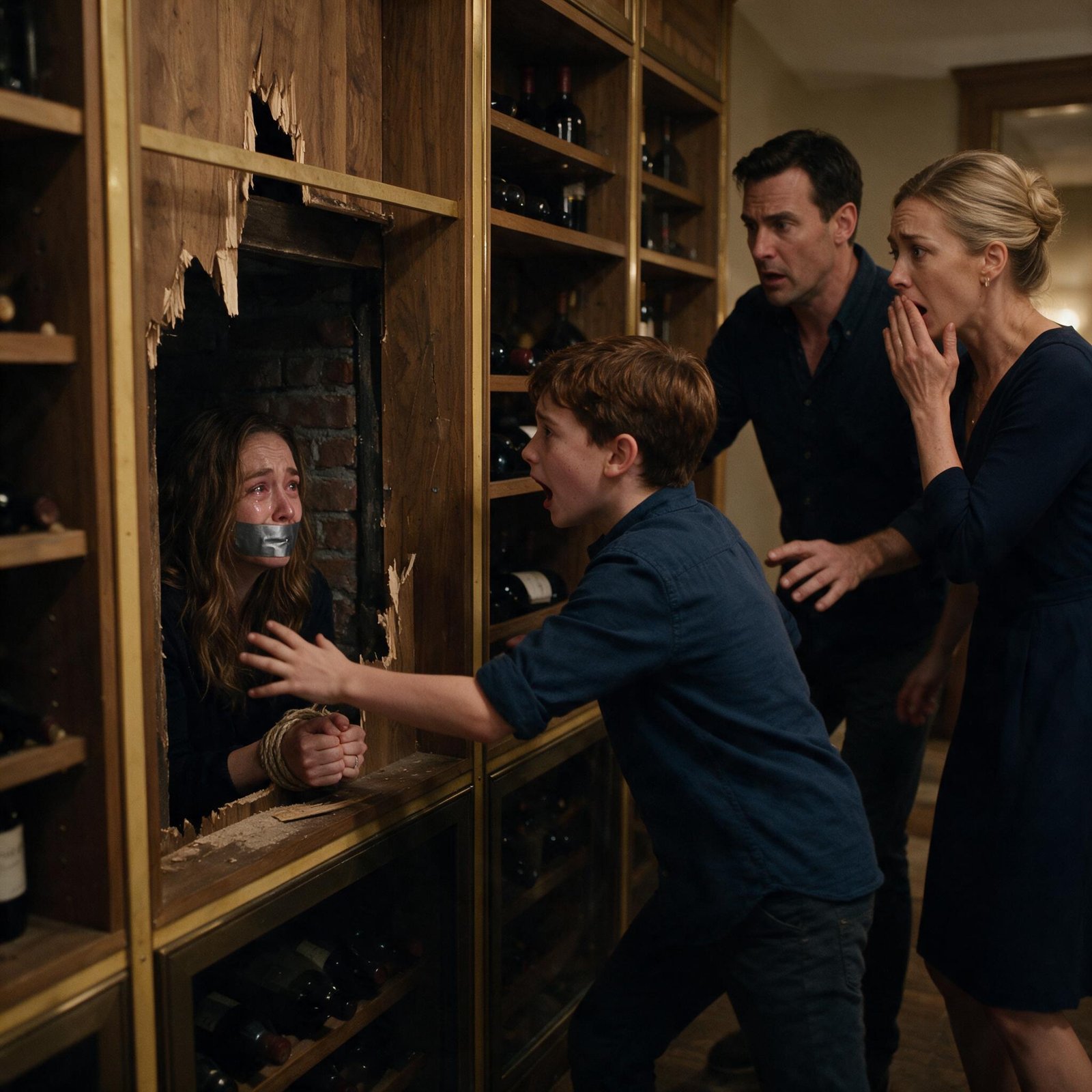
Lisa heard herself say “Ethan, enough” each time she remembered the first crack in the wine rack.
The sentence had lasted one second, but it carried every earlier moment when accepting Richard’s calm explanation had felt easier than trusting the frightened person in front of her.
Three weeks after the dinner, Lisa met Sarah in the small apartment where she had planned to stay after leaving the mansion.
Ethan spent the morning with another trusted relative, which gave the sisters room to speak without asking him to measure their guilt.
Lisa apologized for handing him to Richard and for dismissing him when he pointed toward his mother.
She did not say that Richard had sounded convincing, because being convinced explained her choice without repairing it.
Sarah listened from the opposite end of a modest kitchen table and said she needed facts before she could decide what trust between them might become.
Lisa began with the seven words Richard repeated at her front door.
He had quoted Sarah perfectly, including the pause before “not my son,” then claimed Sarah wanted Ethan returned to the mansion ahead of the family dinner.
Lisa had taken the precision as proof that he and Sarah had spoken privately after the separation.
Sarah had taken Ethan’s absence as proof that Lisa broke her promise the moment Richard applied pressure.
Neither sister had called the other disloyal aloud before Saturday, but Richard’s certainty had allowed the accusation to grow without language.
Lisa forced herself to examine other times that certainty had appeared.
In April, Sarah had admitted that Richard used worry as punishment whenever she refused him, and Lisa answered that concern which punished a woman for saying no was not concern.
The next evening, Richard asked Sarah whether Lisa truly believed his concern was punishment, preserving the unusual pairing of words exactly.
Sarah assumed Lisa confronted him, while Lisa assumed Sarah repeated their conversation during another argument.
In June, Sarah said Richard made every kindness collect interest, a phrase so unlike ordinary complaint that Lisa remembered laughing once before she understood Sarah was serious.
Two days later, Richard told Lisa that marriage was not an account in which kindness collected interest.
Lisa had decided Sarah must have quoted herself to him, and Sarah had decided her sister could not resist trying to mediate.
Both explanations required the women to distrust one another, so neither had looked for a third explanation.
There had been smaller repetitions too, including Sarah’s fear that Richard became most dangerous when he sounded reasonable and Lisa’s warning that an apology should not become a negotiation.
Richard later used “sounded reasonable” and “an apology should not become a negotiation” during separate conversations, always with enough casualness to make certainty feel foolish.
Lisa wrote nothing down, searched no device, and invented no unseen helper to make the pattern easier to accept.
She relied only on memories that Sarah could confirm from the other side of each exchange.
Once they placed the conversations in order, another detail remained consistent.
Every private exchange Richard later echoed had happened during a visit to the mansion.
More specifically, each one happened at the dining table while Richard appeared to be elsewhere in the house.
Sarah usually chose the end chair nearest the wine cellar because it faced the doorway and allowed her to see anyone approaching from the hall.
Lisa had sat beside her, lowering her voice beneath the cooling system’s hum and the faint clink of bottles settling behind glass.
The location had felt safer than a bedroom because no closed door could be accused of hiding a conspiracy.
It had also felt private because the family’s footsteps traveled through the main hall before anyone entered the dining room.
Lisa remembered Richard joining them after one conversation and asking whether they had solved the world without him.
At the time, the joke made both sisters stiffen, but neither recognized it as part of anything larger.
Sarah asked whether Lisa could remember Richard repeating anything they said in her car, at Lisa’s house, or during a walk through the public garden.
Lisa searched each memory and found arguments, assumptions, and ordinary misunderstandings, but no exact language returning through Richard.
The precise echoes belonged to the mansion dining room alone.
Lisa also remembered that Richard had directed the cellar renovation himself, choosing the built-in rack and insisting that the old service wood behind it remain untouched.
Sarah did not forgive Lisa in that moment, and Lisa did not ask her to turn a pattern into absolution.
Lisa had still handed Ethan over, still believed Richard before checking, and still told a terrified child he had done enough when he was the only person refusing the lie.
What she could offer now was accountability without control and memory without a convenient villain beyond the man who had made the choices.
Sarah agreed that Lisa could remain nearby while she rebuilt safety, but visits would happen only when Sarah or Ethan invited her.
Lisa accepted the boundary and returned once more to the facts they shared.
Every secret Richard somehow learned was spoken from the chair beside the cellar.
Part 4 of 5 · The Boy Who Destroyed His Stepfather's Wine Cellar