The Boy the Board Wouldn't Believe
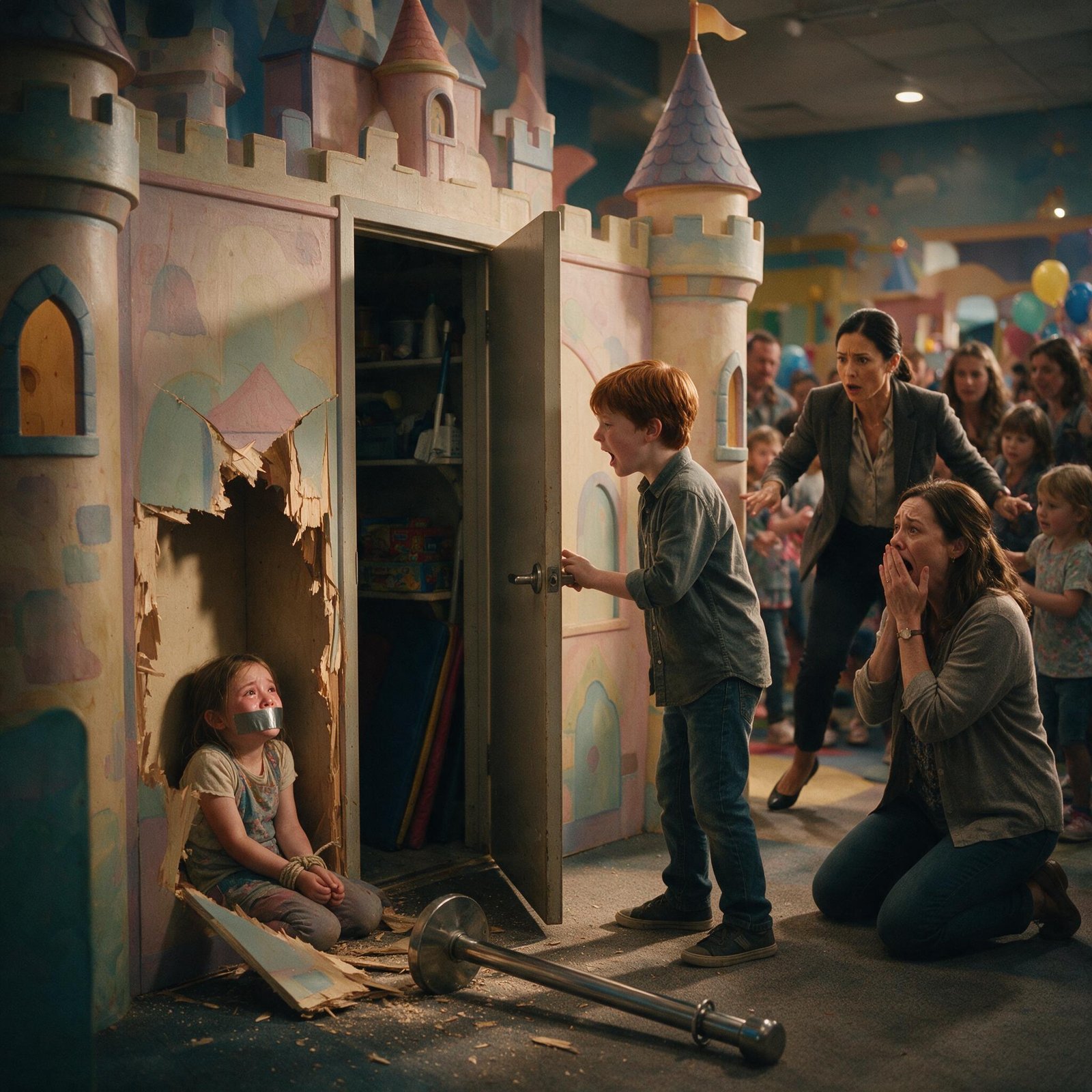
Two days after the charity event, Noah sat at Emily's kitchen table and stared at a pale scrape across his right palm.
Every time he looked at it, he heard plywood split and saw the adults recoil from him before they understood what was behind the wall.
Sophie was asleep upstairs after another medical check and a long night in Emily's bed.
She had been inside the maintenance closet for less than fifteen minutes, but Noah could not make those minutes feel small.
He kept thinking about what Celeste Carter had said before the castle ever broke.
Eighteen days before the event, Noah had been waiting near the art room while Sophie finished a painting class.
A little boy came into the hall crying because he could not find the paper dragon he had made.
Carter told him to lower his voice, but the boy cried harder and reached toward the classroom.
Noah watched Carter clamp one hand around the child's upper arm and force him into a child-size chair beside the open art-room door.
The boy tried to stand, but Carter pressed her other hand against his shoulder and held him in the chair.
It lasted about two minutes before another parent entered the hall and called out when she saw Carter's hand on him.
Carter released the boy and described what she had done as a safety intervention.
Noah saw the red marks her fingers had left above his elbow.
He told Emily in the car before she started the engine.
Emily turned around in her seat, listened without interrupting, and asked him to show her exactly where everyone had stood.
She submitted a formal complaint to the governing board that afternoon and followed up until it scheduled a preliminary meeting.
Six days later, Noah sat beside her in a small conference room while three board members asked him to tell the story again.
He described the paper dragon, the grip on the boy's arm, the chair, Carter's hand on his shoulder, and the parent who stopped her.
Carter listened with her fingers folded on the table.
She did not deny gripping the child or forcing him into the chair.
Instead, she said Noah had misunderstood a safety intervention after becoming agitated himself.
One board member asked whether Noah had ever damaged center property.
Another asked whether he sometimes became loud when adults corrected him.
The crying child disappeared from the questions, and Noah became the problem sitting at the table.
Carter waited until everyone was looking at him before giving him the sentence that would shadow the next twelve days.
“He breaks things when he wants attention.”
Noah remembered Emily saying that his behavior was not the subject of the complaint.
He also remembered the board chair answering that every account needed context.
Context became a tipped box of wooden blocks from the previous winter and a paper banner Noah had torn by accident while helping Sophie down from a chair.
Nobody asked Carter why holding a crying child down belonged in any safe intervention.
The board promised to gather more information, and the meeting ended without anyone speaking to the crying boy's parent in front of Noah.
On the drive home, Emily told Noah she believed what he had seen.
She also asked him to stay away from Carter and remain especially calm at the charity event while the board considered the complaint.
Noah had heard the care in her voice, but he had also heard the condition hidden beneath it.
If he remained calm enough, perhaps adults would decide he deserved the truth.
Now the castle had a broken wall, the queue post had dents, and a room full of witnesses had seen Carter restrain him while he fought to swing again.
Noah pressed his scraped palm flat against the table.
“I did exactly what she said I would.”
Emily sat across from him and did not rush to cover the sentence with reassurance.
“You broke a panel after you heard Sophie, and you kept going after the adults stopped listening.”
Noah asked whether that difference would matter to people who had seen only the post in his hands.
Emily looked toward the stairs before answering.
“It should have mattered eighteen days ago, before you had to prove anything.”
She said she had believed his first account but had still let the board move the burden onto him.
She had asked a twelve-year-old to be perfectly calm so adults might take an allegation about an adult seriously.
She had mistaken patience for fairness and procedure for protection.
“I should have stopped that meeting when they put you on trial,” she said.
Noah wanted to tell her it was all right because he could see how much the admission cost her.
He did not say it because it was not all right yet.
Emily reached across the table with her palm open and waited until he chose to place his hand in it.
For the first time since the castle opened, Noah considered the order of events rather than the noise they made.
Carter had called him destructive before a metal post ever stood beside the plywood wall.
The broken castle had not created her story about him.
She had brought that story into the boardroom twelve days before the charity event.
Part 3 of 5 · The Boy Who Destroyed the Children's Castle