The Pieces That Did Not Match
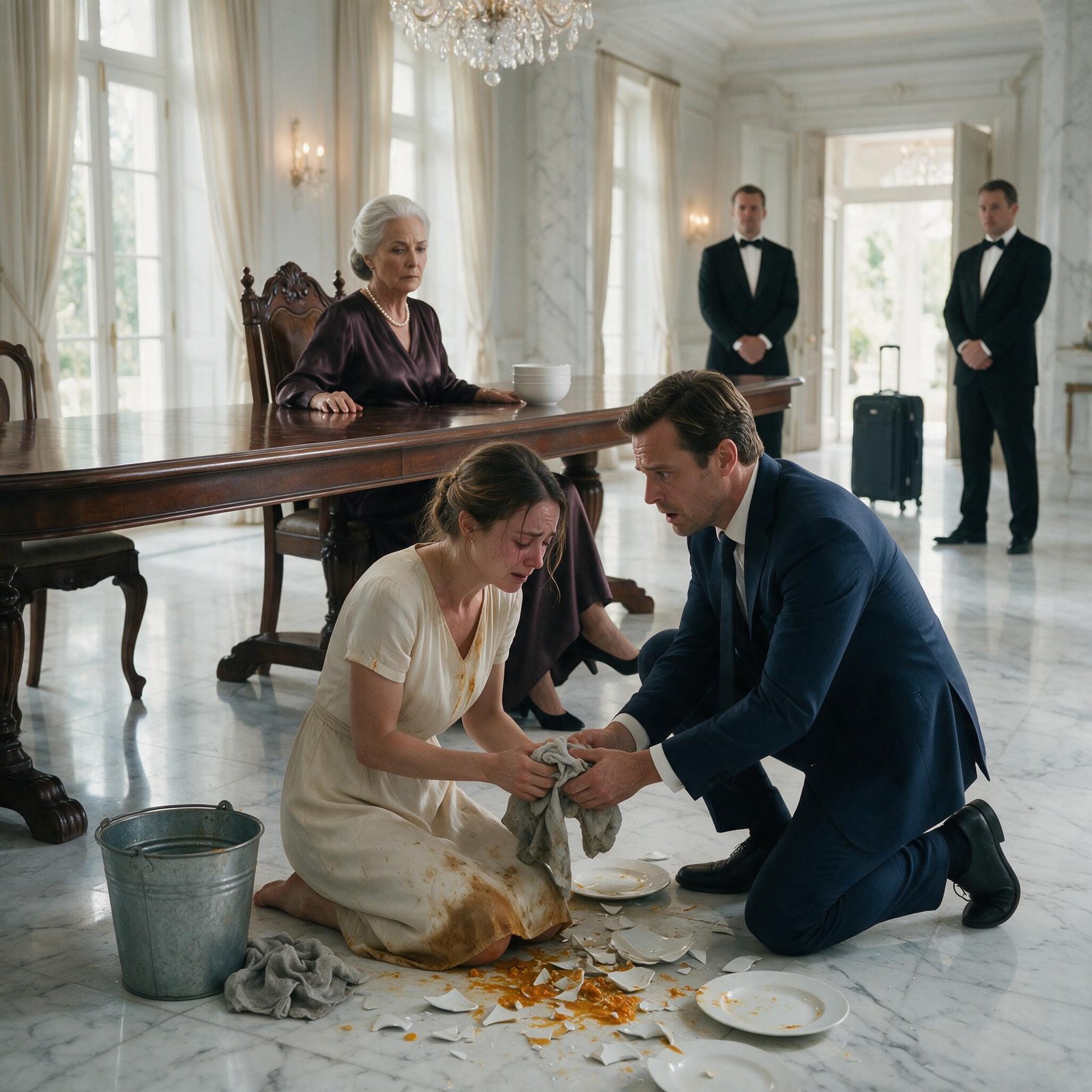
On the morning after Daniel brought her out of the mansion, Emma Carver sat in a ceramic conservation studio that smelled faintly of clay dust and clean cotton.
She had chosen the chair nearest the door, the appointment time, and the people permitted to attend.
Daniel had asked whether he could come, and Emma had agreed only after he promised to listen until she invited him to speak.
He kept that promise as the independent conservator uncovered two shallow trays on the worktable.
One tray held the broken base pieces from the bowl Margaret had thrown beside Emma, while the other held a damaged saucer from the same dining service.
After resigning separately, Arthur Cole and Thomas Reed had each given an independent account of what they witnessed in the dining hall.
Thomas had retained the designated breakage box after Margaret ordered him to discard the shattered bowl, and he brought that box openly to the studio.
Arthur arrived separately with the chipped matching saucer Margaret had already ordered discarded from the dinner service.
Emma watched the conservator turn the largest base fragment beneath a white lamp without pretending the object could answer every question around it.
The largest base fragment carried Briar and Finch 2021 beneath the glaze, the same modern mark Emma had noticed while setting the service out along the dining table before the forced cleaning began.
The conservator compared that code with the mark beneath the saucer.
Although the decoration matched at a glance, the manufacturing marks, edge profiles, and glaze tones showed that the examined bowl fragments and saucer were modern and came from different production lots.
She could not say who had obtained them, whether an older service had existed, or what had happened beyond the objects in front of her.
Emma looked at the broken curve and remembered Margaret lifting the bowl with complete control before sending it into the marble beside her face.
The modern mark made the gesture contradict Margaret's public story, but it did not explain the humiliation or turn the thrown porcelain into the only evidence that mattered.
Arthur had watched Margaret throw the bowl, heard her command Emma to pick it up, and seen Emma shield her face.
Thomas had witnessed the same sequence from another part of the room and had described it without consulting Arthur.
Their direct accounts stood on their own, separate from any question about ceramics.
Neither witness claimed to have understood Margaret's motive or acted as Emma's rescuer while the abuse was happening.
Both said they had feared losing their livelihoods, and Emma refused to turn their delayed courage into another demand that they defend her perfectly.
Arthur's hands tightened once in his lap when he apologized for remaining still, but Emma thanked him for speaking now.
Thomas lowered his eyes and said that watching Daniel kneel beside Emma had shown him how thoroughly everyone in that house had learned to wait for permission.
The sentence unsettled Emma because she recognized the same training in her own automatic claim that she was fine.
Daniel finally asked whether he could say something, and Emma nodded.
He admitted that she had mentioned mounting tension during his three-week trip and that he had reduced it to a conflict they could discuss when he returned.
Daniel said he had not known about the forced cleaning or the bowl, but Emma told him that ignorance did not transform his dramatic return into authority over what happened next.
Daniel accepted the distinction without offering a defense.
Emma said she would not return to the mansion, would not speak with Margaret, and would decide later whether distance from the house was enough distance for her marriage.
Daniel made no bargain, but he repeated her boundaries so she could hear that he understood them.
On the worktable, the conservator aligned the broken base with the saucer, creating a pairing that looked unified only from several feet away.
Up close, the two objects carried different codes, different years, and different small compromises made to preserve the appearance of continuity.
Before forcing Emma onto the floor, Margaret had called her provenance refusal disrespectful, yet the examined pieces now showed why Emma had refused.
The discovery did not make her feel victorious, because the old dining room still existed in her body as a flinch she could not reason away.
It did give her one question that belonged to no husband, foundation, or family legend.
If the bowl and matching saucer were modern, Emma wondered, what had happened to the authentic service Daniel remembered?
Part 3 of 5 · The Husband Who Chose His Wife